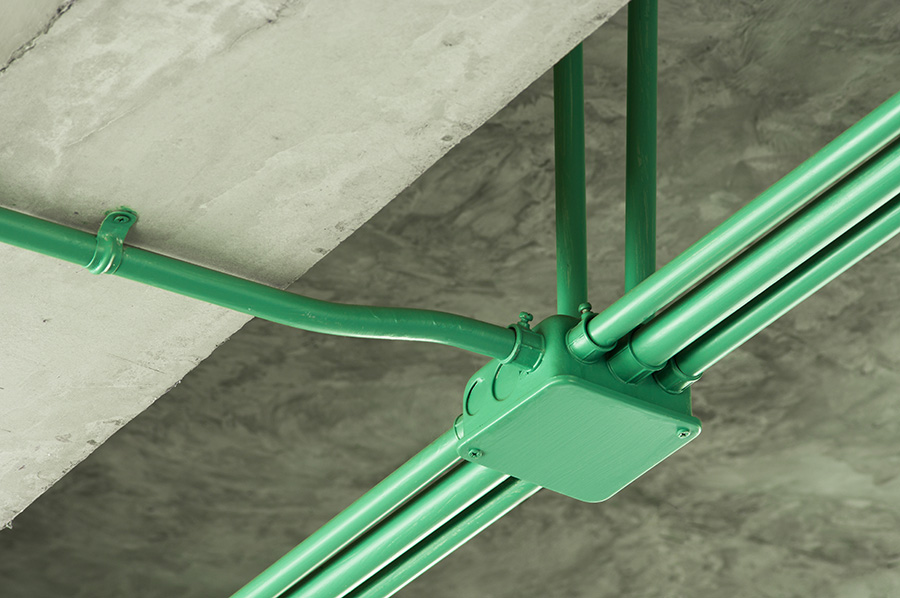
What can be done to keep the inside of electrical conduits from rusting while providing enough slip for electrical wires to pass through? Cortec® has provided the answer with the development of its new EcoShield® VpCI®-386 HT Slip Coating. This is yet another example of Cortec’s role as an innovator in corrosion control, creating exciting new products adapted to specific end user needs.
EcoShield® VpCI®-386 HT Slip Coating is a unique high-heat-resistant water-based DTM (direct-to-metal) coating that offers improved surface slip, excellent outdoor weathering, and thermal heat protection. It significantly retards the reaction of metal ionization and repels water, thus protecting against corrosive electrolytes and aggressive environments. This thixotropic coating resists sagging and running and is thermally stable when dried in ambient temperatures up to approximately 500 °F (260 °C), depending on color choice (Clear, Black, or Aluminum). EcoShield® VpCI®-386 HT Slip Coating offers extended protection in sheltered, unsheltered, indoor, or outdoor conditions and is UV resistant to resist cracking or chipping from prolonged exposure to sunlight.
Why Corrosion Protection for Electrical Conduits?
Corrosion protection is more critical in some environments than others. For example, electrical conduits are more vulnerable to corrosion when stored
outdoors than indoors, or when installed in a tropical, humid climate instead of a hot, dry one. Corrosion protection may be necessary in several phases of the piping life cycle.
1. Outdoor Storage: Manufacturers are often short on storage space, which can cause storage to overflow outdoors. If it rains and the internal coating has not fully cured, the inside of the conduits may flash rust. EcoShield® VpCI®-386 HT Slip Coating minimizes this problem.
2. Overseas Shipping and Storage: Manufacturers sometimes have to ship pipes and tubing overseas, where they may even be stored for six months longer before the customer is able to install them. Again, EcoShield® VpCI®-386 HT Slip Coating can help protect against internal corrosion.
3. Harsh Installation Environments: Industrial facilities must install electrical conduits in a variety of conditions, from dry indoor office spaces to corrosive offshore environments. EcoShield® VpCI®-386 HT Slip Coating can help delay or reduce the corrosion process inside the tubing so
the electrical conduits last longer.
Why a High-Temp Slip Coating?
Slip coatings are very important for electrical conduits because they reduce the coefficient of friction on the inside of the pipes. This makes it easier to push electrical wiring through the tubes when they are installed. By combining a slip coating with Cortec® VpCI® corrosion inhibitors, EcoShield® VpCI®-386 HT Slip Coating helps electrical conduit manufacturers and users tackle two challenges at once. Another important consideration is the temperature required during coating application. Many tube makers must briefly expose piping to extreme heat during the manufacturing process (e.g., to cure coatings). EcoShield® VpCI®-386 HT Slip Coating is therefore designed to withstand high temperatures so it will not be destroyed.
Get Ready to Coat the Conduit!
It can be challenging to protect pipe internals from corrosion, but Cortec® has made it possible with a new Micro-Corrosion Inhibiting Coating designed for this specialty application. By using EcoShield® VpCI®-386 HT Slip Coating, manufacturers can protect against flash corrosion during storage and shipment, and end users can help electrical conduits last longer even after pipes are installed in corrosive environments. Contact Cortec® today to learn more about this high-performance anticorrosion slip coating for electrical conduits: https://www.cortecvci.com/contact-us/
Learn more about EcoShield® VpCI®-386 HT Slip Coating here:
https://www.cortecvci.com/products/vpci-high-performance-coatings/ecoshield-vpci-386-ht-slip-coating/
Keywords: electrical conduits, slip coating, pipe corrosion, pipe and tube manufacturers, anti rust coating, Cortec, VpCI, outdoor storage solutions, Cortec Coatings
Need a High-Resolution Photo? Visit: www.cortecadvertising.com
For a PDF version please click here.